Showing posts with label Textbook Assignment 2. Show all posts

Friday, March 20, 2015

Informational Book Evaluation Criteria

According to Sylvia M. Vardell’s book,  Children’s Literature in Action: A Librarian’s Guide, when informational books are selected for children and young adults, it is imperative that the highest standards be met. This however can be tricky so she writes that “the number one criteria for quality in nonfiction writing is (the) accuracy of information.
When selecting nonfiction/informational books the following four things must have to be considered:
  1. Accuracy
  2. Design
  3. Organization
  4. Style
Vardell, S. (2008). Children's Literature in Action: A Librarian's Guide (1. publ. ed.). Westport, Conn. [u.a.: Libraries Unlimited.

Non-Fiction: Accuracy

As mentioned previously, Vardell believes that the most important element when evaluating Informational books is their accuracy.  She goes on to write that no “matter how lovely the illustrations are or how positive the reviews” an inaccurate book can and will only misinform children. But how, she asks, are we supposed to know if the information presented is accurate? 
  • One way is to pay attention to reviewers, who are they and are the experts in their field of knowledge? 
  • Another way is too check for citation in their notes and if a bibliography is included.

Vardell, S. (2008). Children's Literature in Action: A Librarian's Guide (1. publ. ed.). Westport, Conn. [u.a.: Libraries Unlimited.

Hitler Youth


ACCURACY

Bartoletti’s book addresses an area of history that has been somewhat  ignored by American audiences.  It is a dependable source of information that relies on personal interviews (primary sources) with people who bore witness to the atrocities of Nazi Germany and people who were participants of the Hitler Youth.


Bartoletti, S. (2005). Hitler Youth: Growing up in Hitler's shadow. New York: Scholastic Nonfiction.

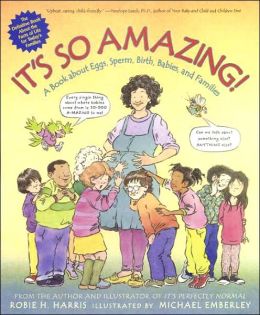
It's So Amazing: A Book about Eggs, Sperm, Birth, Babies and Families


ACCURACY


Many an irate parent has demanded that this book be pulled off the shelves of their public libraries because they deem this richly informational book to inappropriate for the eyes of their children.  Robie Harris does a wonderful job at taking such a sensitive topic and making it relatable to kids without editing or glossing over knowledge that is absolutely necessary that they learn. One way the reader can feel confident in the accuracy of this book is the number of medical professionals used in as sources.

Harris, R., & Emberley, M. (1999). It's so Amazing!: A Book about Eggs, Sperm, Birth, Babies, and Families. Cambridge, Mass: Candlewick Press.

Spiders


ACCURACY
Nic Bishop is a respected author who has researched and penned a plethora of informational books.

Perhaps Bishop’s success can be attributed to the ease of the text. Like his other books this one is filled with photographs that at once provides information for his young readers but also tantalizes them.

The reader can find a picture of new spider on every page that is accompanied by easy to read information.


Bishop, N. (2007). Spiders. New York: Scholastic Nonfiction.

Non-Fiction: Organization

Vardell notes that most “informational books are not read from cover-to-cover” and that as a result the organization of a book is what helps a reader “pick and choose what” they need.  Things like clear headings, table of contents, indexes and even patterns all help to the organization of non-fiction books.


Vardell, S. (2008). Children's Literature in Action: A Librarian's Guide (1. publ. ed.). Westport, Conn. [u.a.: Libraries Unlimited.

How They Croaked: The Awful Ends of the Awfully Famous


ORGANIZATION

This is a morbidly fascinating book.  It informs its readers about the demise of historical notables like Caesar who received a total of 29 stab wounds but only 1 that was actually fatal.  Georgia Bragg’s sardonic tone is perfect for the middle and high school level student. She notes that celebrity pharaoh, King Tut was still dead the 4th time he was exhumed from his sarcophagus.  The key to the success of this book is that even though Bragg provides an enormous amount of information it is well organized.  The text provides a picture of the deceased, a short narrative of how the “awfully famous" person died.

Bragg, G., & Malley, K. (2011). How They Croaked: The Aweful Ends of the Awfully Famous. New York: Walker &.

We Are the Ship


ORGANIZATION

Nelson’s book explores the history of the Negro National League.  This book introduces readers to great baseball legends like Oscar “Cyclone”
Charleston and “Smokey” Joe Williams.   Nelson organizes the book into 9 “innings” that are accompanied by an “extra innings” page that talks briefly about the end of the league.  It is a history book, jam-packed with information, but it doesn’t read like a boring textbook.  This is partly because of Nelson’s narrative and the other because of his beautiful oil paintings.

Nelson, K. (2008). We Are the Ship: The story of Negro League baseball. New York: Jump at the Sun/Hyperion Books for Children.

Primates: The Fearless Science of Jane Goodall, Dian Fossey and Birute Galdikas


ORGANIZATION

Ottavaviani weaves the trials and accomplishments of Jane Goodall, Dian Fossey and Birute Galdikas in seamless and style.  The information is detailed but saved from being a cold read with the addition of the emotional accounts of these scientist, whose research has heavily influenced the world of Primatology. It is also refreshing that he is able to integrate the voices of these three scientific giants so that the reader is able to clearly distinguish between the three of them.

Ottaviani, J., & Wicks, M. (2013). Primates: The Fearless Science of Jane Goodall, Dian Fossey, and Biruté Galdikas. First Second.

Non-Fiction: Design

DESIGN

“The artful appearance,” Vardell writes, “…is also an important factor.  First one considers whether the book is attractive (and) inviting…” 
It would seem that readers do judge a book by its cover.  It is important then, that informational books contain appropriate illustrations that compliment the text and that other graphics be placed appropriately.  Even font size and type are important.

Vardell, S. (2008). Children's Literature in Action: A Librarian's Guide (1. publ. ed.). Westport, Conn. [u.a.: Libraries Unlimited.

Balloons Over Broadway


DESIGN

This, could-have-been an overly busy, book tells the story of Tony Sarg and his contribution to the iconic Macy’s Parade.  The design layout includes multimedia and simple pencil drawings.  The book is saved from being a sensory overload by the simple but informative text.

Sweet, M., & Newborn, R. (2011). Balloons over Broadway:The True Story of th the Puppeteer of Macy's Parade. Boston, MA: Houghton Mifflin Books for Children.

Non-Fiction Style

STYLE
Vardell believes that style “is what makes an informational book a work of literature and just a book of facts.”  She argues that “a close examination of the rigorous criteria that are applied to the very best informational books helps demonstrate that this genre is a valuable and even beautiful means of expression”
Those evaluating style must look for the “distinctiveness in the presentation of the information.” This can be looked for in the author’s writing and it should be “clear, lively and interesting.:"

Vardell, S. (2008). Children's Literature in Action: A Librarian's Guide (1. publ. ed.). Westport, Conn. [u.a.: Libraries Unlimited.

ROSA


STYLE

Poet Nikki Giovanni tackles the task of writing an informative story about one of the notable symbols of the American Civil Rights movement.  Giovanni’s sharp writing style and Bryan Collier’s illustrations allow students to see Rosa Parks as a normal person with normal worries and normal responsibilities before she was thrust into the spotlight during the Civil Rights movement in the United States. 


Vardell, S. (2008). Children's Literature in Action: A Librarian's Guide (1. publ. ed.). Westport, Conn. [u.a.: Libraries Unlimited.