Showing posts with label Textbook Assignment 3. Show all posts

Friday, March 20, 2015

Realistic Fiction Evaluation Criteria


Vardell, S. (2008). Children's Literature in Action: A Librarian's Guide (1. publ. ed.). Westport, Conn. [u.a.: Libraries Unlimited.


Dear Mr. Henshaw

STYLE & THEME
In her 1984 Newberry Award winning novel, Dear Mr. Henshaw, Beverly Cleary tracks the emotional and mental growth of Leigh Botts through a series of letters and journal entries.  The style she chooses differentiates itself from similarly styled books because the reader is able to see the gradual change in Leigh’s writing as well as his outlook on life. 
Thirty years later, this style still hooks children’s attention. This happens because Leigh is made more relatable to young readers because of his less-than-perfect writing. After all, what 2nd grader writes perfect sentences?
The theme that probably strikes the deepest chord is that of understanding others.  Divorce is never easy and is especially hard on children.  Leigh must deal with the sorrow over his dad’s leaving and how lonely and tired his mom is.  The theme crystalizes when Leigh allows his beloved dog, Bandit, to leave with his father; he does this so that his dad will not be so lonely.

Cleary, B., & Zelinsky, P. (1983). Dear Mr. Henshaw. New York: Morrow.

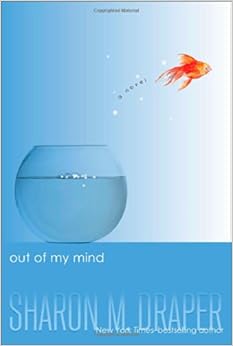
Out of My Mind


SETTING & GENDER ROLES
11 year old Melody, the protagonist of this story, is a strong female lead who possess a body that is ravaged by Cerebral Palsy but also lays claim to a sharp mind.  She is mislabeled mentally disabled because of her inability to talk.  Through the wonder of technology she is finally able to communicate with her family, doctors and teachers.   It is at this point when her world tilts on its axis and she is able to enter the “real world.”  However, she must still scale over the obstacles of ignorance and other’s fear of her differences.  Even through all of these challenges, Melody doesn't give in.

The most important setting of this book is Melody’s school, Woodland Elementary.  Vardell writes that it is imperative that children’s novels have a setting that is believable and accurate and there is nothing more familiar to an elementary aged child than the halls and rooms of an elementary.

Draper, S. (2010). Out of My Mind. New York: Atheneum Books for Young Readers.

Rules


CHARACTERIZATION & PLOT
In her evaluation criteria Vardell states that a good novel has characters with who the reader can easily identify with.  Emotional growth, she believes, is much more important than even plot development and this is evident in Lord’s novel. 
Catherine starts off as a girl so bogged down with embarrassment that she creates rules to try and “normalize” her Autistic bother.  Over the course of the story she develops in to a young woman who learns to accept others for who they are; part of this growth comes from the realization that although we cannot change how other people perceive us, we can change how we perceive them. 
The plot of the story centers on Catherine’s initial embarrassment and is expertly handled by Lord. Catherine’s rules for her brother may have roots in discomfiture but it is tempered by the genuine love she has for him.  This is something that is true to life and something that young readers can easily relate to.

Lord, C. (2006). Rules. New York: Scholastic Press.

A Crooked Kind of Perfect

GENDER ROLES & STYLE
This book has a style that is full humor and that highlights the protagonist’s tenacity.  There is a maxim that states that the best things usually happen unexpectedly.  This is true for ten year old Zoe Elias who has aspirations of becoming a Carnegie Hall pianist. In order to reach this lofty goal she knows she needs a piano to practice on.  She receives a multi-keyed musical gift from her parents but not the one she wanted. Instead of a majestic piano she gets an old organ. Rather than bemoaning the mix up, she begins organ practice and enters a competition.

Aside from conquering the organ, Zoe must deal with a workaholic mother and anxious father.  The gender role reversal in the story is well-handled, believable and something that children in our ever-changing and tolerant society will be able to relate to.  

Urban, L. (2007). A Crooked Kind of Perfect. Orlando: Harcourt.

Timmy Failure: Mistakes Were Made


CHARACTERIZATION & STYLE

One can’t help but think of the overconfident Greg Heffley and the infamous duo Calvin and Hobbs when reading this book. Young Timmy Failure- no, that is not an auto-correct error, it really is his name- is a brash young man who copes with the sudden changes in his life by using his detective skills to help his classmates and through his journal writing.  Jimmy also deals with his parent’s divorce and failing grades by relying on his friendship with his imaginary friend Total, who just happens to be a one ton polar bear.

The book’s style, which consists of witty entries and clean lined doodles make for an appealing read.  This style choice, which is forever synonymous with the Diary of a Wimpy Kid series, allows one to witness first-hand the thought process of a not-so-perfect main character.  Pastis also includes letters from other characters which helps develop the characterization of his protagonist. 


Pastis, S. (2013). Timmy Failure: Mistakes Were Made. London: Walker.

Bridge to Terabithia


THEME & SETTING


The setting of this childhood classic is a somewhat backwards rural town that is bordered by forests and creeks. It is in the confines of this setting that the protagonist and his friend are able to create an imaginary kingdom that helps them escape from the banal existence of their small town.  Aside from the fact that the Jess and Leslie have the freedom to roam the great outdoors without adult supervision, something that the hyper-vigilant parents of this current generation would frown upon, this story could be one that was set in present day Virginia.

One of the major themes is courage. This can be seen when Leslie joins the boys in their footrace; she shows courage by standing up for girls’ right to run with boys. This theme can also be seen when she has the courage to empathize with a sobbing Janice, who has bullied for not having a television.

Paterson, K. (1977). Bridge to Terabithia. New York, NY: T.Y. Crowell.