Showing posts with label Textbook Assignment 1. Show all posts

Friday, March 20, 2015

Paperbag Princess


CHARACTER
Vardell believes that the thing that makes storybook characters memorable is not they are “cute, sweet, and well-behaved, but by being very individual with a strong self of self.”
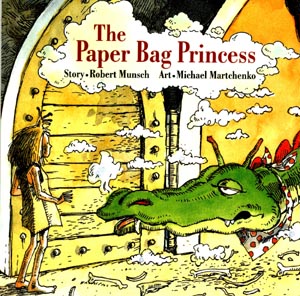
Princess Elizabeth proves her strength and embraces her individuality after a dragon kidnaps the prince she is to marry.  After outwitting the dragon- in a paper bag shift because the dragon singed her clothe off-she realizes that the obnoxious prince is just not the right fit for her and doesn’t marry the “bum.”

Munsch, R., & Martchenko, M. (1992). The Paperbag Princess. Annick Press.

My Teacher is a Monster


SHAPE
Vardell notes that shapes “can convey action” and they are another way to emphasize the mood of a picture and story.  In this book the irregular shape of Ms. Kirby’s monstrous and the sharp points of her black shoes emphasize Bobby’s fear of her. The severe line of Ms. Kirby’s brow serves to highlight her severity.  As Bobby begins to discover his teacher’s true nature, her face begins to morph into a soothingly round and quite human face.  This transformation indicates the shift in Bobby’s mood from that of a terrified, frustrated student to one that is comfortable with his teacher.

Brown, P. (2014). My Teacher Is a Monster! (No, I Am Not.). Little, Brown Books for Young Readers.

The Three Pigs


TEXTURE
Wiesner’s story starts off traditionally but when the 1st pig is literally “huffed” and “puffed” off the pages of his vanilla world, the reader knows they are in for a special treat.  Fractured fairy tales, in the hands of an inept storyteller, can be shattered beyond any hint of recognition. Weisner’s juxtaposition of traditional storybook drawings and colors along with his stunningly multi-dimensional illustrations save his book from this fate. The effect also brings dimension to an otherwise flat world.

Wiesner, D. (2001). The Three Pigs. New York: Clarion Books.

Mirror Mirror


COMPOSITION
This brilliantly hued book, which was illustrated by Josée Masse, exemplifies Vardell’s belief that Composition “unifies all of the (visual) elements.”  Masse’s use of lines alternate between danger and tranquility. , the lines indicate danger or tranquility. In “The Sleeping Beauty and the Wide-Awake Prince,” sharp edged tree branches allow lurking evil, but the roundness of her dress is soothing.
Shape deals with the mood of the illustration.  For example, “In the Hood” the verse of Little Red Riding Hood, the illustration is the wolf interwoven in the drawing of the forest and Little Red unaware.  The pointy shape of Little Red Riding’s hood conveys the precarious situation she is in.

Singer, M., & Masse, J. (2010). Mirror mirror: A Book of Reversible Verse. New York: Dutton Children's Books.

Olivia


COLOR
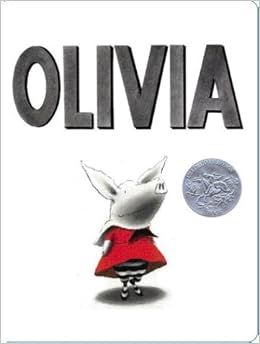
Ian Falconer’s debut book, Olivia, is based on his rambunctious niece.  Olivia, the piglet, is daring and sassy, highly imaginative and above all, high energy.  Falconer captures Olivia’s vivid personality by filling the crisp white pages of this preschool-friendly book, with black and white drawings.  By doing so, the reader is able to focus on the character’s facial expressions.  The only splash of color comes from Olivia herself whose signature color is red.  This choice perfectly captures the connotations, we as readers, associate with the color: Warmth, friendliness and powerful vivacity.  After having read the book, the reader will forever connect this color with Olivia as well.

Falconer, I. (2000). Olivia. New York: Atheneum Books for Young Readers.

The legend of the Bluebonnet


THEME
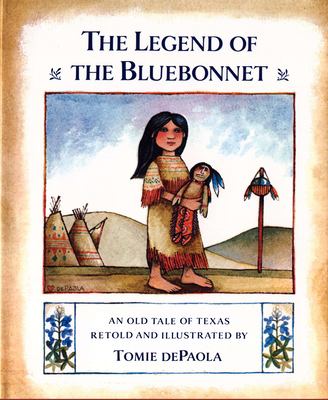
Vardell notes that theme is a “sticky area” of contention in children’s literature circles.  The debate ranges from those who seek deep meaning to those that argue that this doing so is an act of didacticism.  One book that is safe from this debate is dePaola’s book because the value of self-sacrifice for the greater good of the whole is an obvious, some might say blatant, theme. When She-who-is-alone sacrifices the only memento left to her by her deceased parents she ends the long famine that has plagued the Comanche people. 


DePaola, T. (1983). The legend of the bluebonnet: An old tale of Texas. New York: Putnam.

This Is Not My Hat


LINE
Vardell writes that “lines can set the mood or convey movement” while providing “a feeling of valance, motion or distance.”  The motion in is evident in all the pages of Klassen's underwater hat-nabbing caper.  When the books smoothly round protagonist steals a much larger fish’s hat, the reader’s eye is immediately drawn bottom of the page where the gentle lines of the assorted  sea flora seem to sway in an invisible underwater current.  The lines of these sea greenery then seem to stand rigid when the larger fish wakes up and realizes that his hat has been nabbed.  They then seem to curve as if jolted forwarded when he swims after the overconfident hat thief.


Klassen, J. (2012). This Is Not My Hat. Candlewick.

It's a Book


STYLE
Vardell cites Rebecca Lukens recommendations about what to look at when looking “at an author’s use of ‘devices of style.’  These devices can be their use of figurative language, imagery and word play. Smith is a master of the latter.  An example of this would be his play with puns.  For example when the technology inclined jackass asks the monkey as to the location of his book’s mouse, the tiny hat perched on the monkey’s head lifts and an tiny, brown furred mouse pops out and replies, “Here I am.”

Smith, L. (2010). It's a book. New York: Roaring Brook Press.

Where the Wild Things Are

PLOT

Vardell makes the observation that picture book plots may be very simple but that “there should always be some conflict that grows out of a situation that is believable and relevant to the young child.”
Nothing, perhaps, can be more believable than a young child feeling wrongly punished and longing to escape to place where their riotous behavior is welcomed .  Sendak’s classic captures this idea perfectly and resolves itself when Max realizes that he misses his mother and the structure that her rules provide.


Sendak, M. (1963). Where the Wild Things Are. New York: Harper & Row.

Wednesday, February 25, 2015

MARTINA THE BEAUTIFUL COCKROACH


ILLUSTRATIONS
What would a picture book be without amazingly beautiful illustrations?  Vardell cites children’s literature expert Zena Stherland who believes that “the illustrations in a picture book should have storytelling qualities (that) …reflect(s) warmth and vitality” whether it be “through rich and harmonious color or appropriate monochrome.”  Michael Austin’s bight palette, clean lines and rounded curves do this and bring this old Cuban tale to life. 
CULTURAL MARKERS
Vardell believes that it is “important to consider how words and pictures are used to depict culture in children’s picture books” and urges her readers to “seek out (only) the very best to share with young readers.”  She also notes that cultural authenticity can be verified through a book’s illustrations.  Deedy’s book is sprinkled with sprinkled with Spanish words and Smith’s illustrations depict a beautiful, if shabby, Cuban setting.  What is perhaps the clearest culture marker in this book is the respect and love paid to the Cuban grandmother.

Deedy, C., & Austin, M. (2007). Martina, the Beautiful Cockroach: A Cuban folktale. Atlanta, GA: Peachtree.